Showing posts with label Hiroshima. Show all posts

Friday, December 27, 2013

11 Hiroshima es Miyajima

Mielott felkeresnenk hiroshimai szallasadonkat, akit szinten Couchsurfing-en keresztul talaltunk, ugy dontunk jo volna vacsorazni. Egy kedves kis etteremben joizuen falatozzuk a hires hiroshimai okonomiyaki-t, mikor mellenk telepszik egy masik kulfoldi. "Ti is Masashi-san nal szalltok meg ma este?" -kerdezi. Nem tudom hogyan jutott eszebe ezzel a kerdessel ismerkedni egy hatalmas varos kellos kozepen, de telibe talalt. Masashi-san furcsa figura. 30 ev koruli srac, hatalmas berelt lakasa egy tombhaz legfelso ket emeletet foglalja el, szallovendegeket gyakorlatilag folyamatosan fogad, egyszerre akar tizet is, es allitolag a lakast csupan a vonalas telefon es fax miatt tartja fenn, melyre a vallalkozasanak van szuksege. Felmerul nehany miert es hogyan kezdetu kerdes a fejemben, de aztan mivel nem ram tartozik, nem teszem fel oket. Lenyeg, hogy tagas, kenyelmes szallasunk van, a hazigazda pedig segitokesz es baratsagos, ugyanugy, mint a velunk egy idoben nala letelepedett hat tovabbi vendege. 

A kovetkezo nap a varosnezese. Kisse szemerkelo esoben indulunk Miyajima fele, mely a Hiroshimai obolben meghuzodo kis sziget neve, es egyben kotelezo latnivalo a tersegben. Mire a komphoz erunk, a szemerkelo eso csorgo esore valtozik es egyaltalan nem mutat semmi hajlandosagot az enyhulesre a kozeljovoben. Az utazas ismet tanit nekunk valamit. Megpedig azt, hogy a legszebb helyek is csak ritkan neznek ki ugy, mint a kepeslapokon. Igy pl a gigantikus vorosre festett sinto kapu, mely csak ugy lebeg az obol vizen remego tukorkepe felett a mogotte colopsorra epitett templomegyuttessel egyutt (Itsukushima szentely), kiderul, hogy megiscsak massziv talapzaton all. Ugyanis nemcsak hogy tukorkep nincs, de meg viz sem. Hogy a lebegest ne is emlitsem. Erkezesunkkor teljes apaly van es ugy all ott minden a csorgo esoben, mint a keszuletlen mezitlabas kisdiak a tabla elott leforrazva. Hat ez van, ezt kell elfogadni. Sot, ebben kell a szepet es jot megtalalni, mert ugye azert ebben is van olyasmi boven. Nem lehet minden es mindenki mindenkor mindenre felkeszult. Meg egy ilyen turistalatvanyossag sem a turistakra. Ez is az elethez tartozik, ahogy az eso is meg az apaly is. Atlatszo olcso muanyag esokabatjaink pedig olyan jo szolgalatot tesznek, hogy a maskor bizonyara mindenfele szabadon koszalo apro termetu japan szarvasok is csak irigykedve tekintgetnek utanunk a gyenge alkalmi menedeket nyujto hazereszek alol. 

Az apalyban arvalkodo Otorii (Nagy Kapu) az Itsukushima szentely felol nezve 
Az esoben meg a terkep keskeny fedele is nyujt valamennyi vedelmet :)

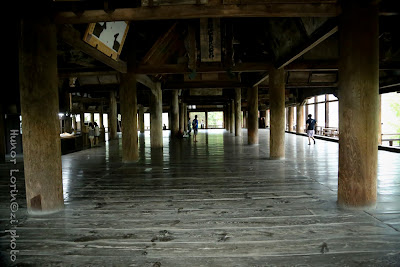
Lenyeg, hogy nezzuk a dolgokat pozitivan. Az esos ido ujfajta elmenyekre is lehetosegat ad. Arra sarkall ugyanis, hogy keressunk lehetoseg szerint fedett latnivalot. Fenn a dombon, lombos fak mogott elrejtozve szepen ra is bukkanunk egy hatalmas, teljesen fabol epitett templomra, a Senjokaku-ra (az ezer tatami matrac pavilonja) http://www.japan-guide.com/e/e3452.html, mely megtermett emberdereknal is joval vastagabb evszazados fa oszlopsoraival, nyitott oldalaival, impozans mereteivel kifejezetten hivogato lehet meg napsuteses idoben is.  Valami olyan hely ez, ahonnan nem szivesen indul tovabb az ember, holott a belso falakra es vaskos gerendakra kifuggesztett festmenyek serult lovakrol, haboruban vagdalkozo emberekrol, harci hajokrol egyaltalan nem tul baratsagosak. Hanem maga a tobb szaz eves fa szerkezet az ido barazdalta oszlopok, a kimeletes hasznalatban tokeletesre fenyesedett deszkapadlozat tortenelmet rejt magaban. Ha van ideje az embernek kisse meglassulni, mindezt nemcsak megnezni, hanem egeszen kozelrol a rostok koze belatni, szinte hallani lehet, erezni a csond mogott a multat, mely bolcsesseget rejt a figyelmes lelek szamara. Es mindehhez mintha kulon ajandekkent kaptuk volna, a kinti esofuggony olyan lagyan zar korul minket, mintha csak hangsulyozni szeretne a belso csondet es bekesseget. 

A Senjokaku templom 

A Senjokaku belulrol

A Senjokaku egyik alkalmazottja oson vegig a fenyes deszkapadlon

Az eso nem akar enyhulni, de mar nem is zavar. Teszunk meg egy laza setat a kisvaroska tulso feleben egy masik dombon felepult buddhista templomegyuttes, a Daisho-in fele http://www.japan-guide.com/e/e3453.html. Az epuletek kozt kanyargo setanyok es lepcsosorok menten szazaval elhelyezett apro kis vidam szobrocskak (u.n. jizo szobrok) lattan lehetetlen nem felvidulni. Az eso monoton neszezese mogott dobolas hallik, meg egy szerzetes hangja, amint szutrakat kantal. Utazas ez is a lelek es a lathatatlan valosag vegtelen utjain. 

Az egyik templomhoz felvezeto lepcsosor a Daisho-in teruleten. Amennyiben menet kozben meporgeted a bal oldalon lathato imahengereket, az annyit tesz, mintha a rairt szutrakat mar el is mondtad volna. 

Kis vidam "jizo" szobor. O es meg a kertben talalhato tobb szaz hasonlo tarsa a gyerekek vedoszentjeit formazzak meg.  

Ok akar Szende, Szundi, Hapci, Morgo, Kuka, Tudor es Vidor is lehetnenek, de nem ok. Tovabbi "Jizo" szobrok.


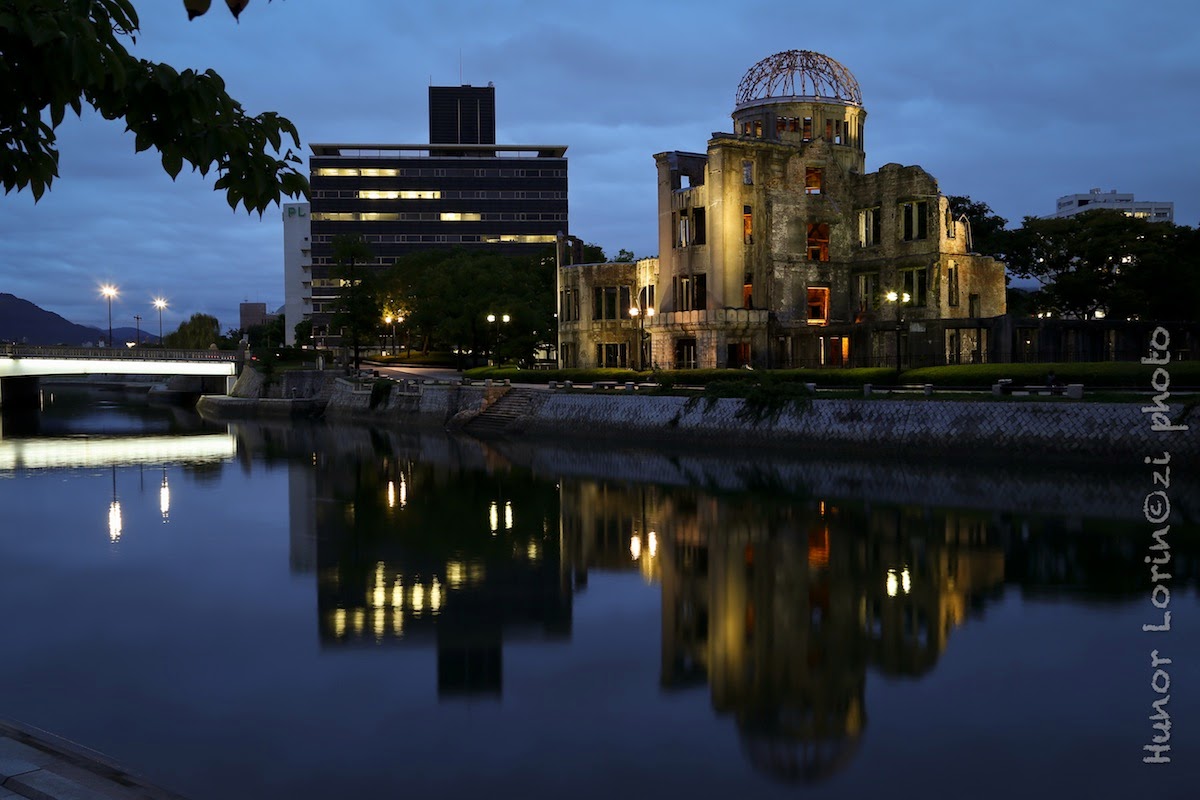
A mai napra viszont akarhogyan is nezzuk, az idonk veges es raadasul gyorsan is telik, es mi meg szeretnenk idoben visszajutni a hiroshimai Beke Emlekpark-ba is. Hiroshima neve azt hiszem sokunk szamara a vilagtortenelem egyik legborzalmasabb esemenye kapcsan ismert. Annak az epuletnek a maradvanya, mely folott 1945. augusztus 6-an ama bizonyos atombomba felrobbant, ma is helyreallitatlan formajaban lathato, orokre arra intve az emberiseget, hogy tanuljon multbeli hibaibol. Es erre az intesre egeszen biztos, hogy mindeki, aki erre jar mindig emlekezni fog. Fokeppen, ha a szep tagas, zoldello park kozepen a muzeumban is tesz egy setat, mely egeszen testkozelbol, szemelyes sorsokon keresztul mutatja be az atomrobbanas borzalmas kovetkezmenyeit. A muzeumban virtualis seta is teheto a kovetkezo veboldalon: http://www.pcf.city.hiroshima.jp/virtual/VirtualMuseum_e/tour_e/tour_fra_e.html 

1945. augusztus 6-an reggel 8.15-kor egy amerikai B29 bombaszallito repulo ledobta a vilag elso atombombajat. A bomba korulbelul 600 meteres magassagban robbant a Hiroshimai Megyei Ipari Bemutatokozpont epulete felett. A bomba ereje gyakorlatilag az egesz varost lesoporte a fold szinerol. Ennek az epuletnek a fo falai, mivel a legnyomas kozvetlenul felulrol erkezett, allva maradtak. 

Amikor megallt az ido...

  
A robbanas elott...

… es utan...

Minden alkalommal, amikor a vilag valamely orszagaban atomrobbanas tesztelest hajtanak vegre, Hiroshima polgarmestere levelet kuld, tiltakozva az atomenergia hasznalata ellen. 
Odakint az eso alabbhagyott es az eg lassan felderult mire koruljartuk a muzeum minden zeget-zugat, viszont megis megnehezult, elfelhozott lelekkel indulunk neki gyalogosan az immar esti szurkuletbe hajlott utcaknak. Utunk egyenesen a szallasunk fele vezet. Nem sokat beszelgetuk. A muzeum altal elenk tart mult latvanyat megemeszteni nem konnyed feladat. 


Masnapra az eso ujra teljes erejevel omlik az elsotetult varos nyakaba. Ugy hatarozunk, nem kell mindig menni valamerre. Az egesz napot hatalmas, tagas szallasunkon toltjuk pihenessel, ezzel-azzal, es kozben halas a szivunk, hogy ebben az idojarasban biztos fedel van a fejunk felett.  

11 Hiroshima

This was my second visit to this very touristy area of Japan. I have been here 10 years ago, visiting Japan for the first time as a student majoring in Japanese with a scholarship from the Japan Foundation. The beauty of Miyajima amazed me and the horror of the atomic bomb explained in detail at the Peace Memorial Museum struck me and I thought these are two things that should not be missed while in Japan so I wanted Hunor to be able to see these places. 
Well, we were not very lucky. After all the amazing sunny weather we got in the first weeks, it started to rain, a typhoon was on it's way. We were still very enthusiastic tourists, so we got up early in the morning and went to Miyajima, to get there before the crowds arrive, but it was hard to see the beauty of the place from under our plastic ponchos and through a curtain of rain. Even the deer who always wander around in the park stood freezing under cover. We arrived relatively early, so we headed for the must see, Itsukushima shrine, which is a shirne complex on the shore and a huge red shinto gate in the sea. Again we were not lucky, because apparently at high tide it looks like it is floating on the sea with the temples built on stilts right on the shore facing it. We came at low tide so it was not a breathtaking view. I started to get frustrated with the cold and the rain and our bad luck, but Hunor took it very well, so I managed to tune in to his mood and give up on trying not to get wet and simply stop complaining and it worked. One thing I got to learn (and have to practice more and more) while traveling is that when you give up all the expectations that exist nowhere else but in the guidebooks, in people's stories and in your imagination, you are finally free and open enough to embrace a place as it is at the moment you are there. We explored some of the more unknown temples in the back of the complex and had an amazing time. Senjokaku  (Pavilion of 1000 tatami mats) is just behind the Itsukushima shrine up on a hill. It was a massive hall, the ceiling and the walls full of paintings and sculptures of horses and battles and boats, each one with a mystical story lurking behind it. What we both liked most about the hall was the flooring. Hundreds of years old wooden floors, it felt like those immense pieces of wood with their simplicity could tell more stories than the banners and paintings above. For a few minutes I just walked and danced around on them, feeling their energy, stillness and patience. Then I sat down by one of the huge pillars on the ground and just watched the rain and listened to the thunder for the next half an hour. 

the shinto gate at low tide

When I go to a place I want to enter its atmosphere. It is something like being able to hear the heartbeat of a place for a short while. It is something beyond the guidebooks and beyond my understanding. It is a short period of time, sometimes a moment, sometimes an hour when a place with all its generosity and love turns to me, opens up for me and all my senses are fulfilled with its character. I feel the colors on my skin, I smell stories in the air and see sounds around me. I never know where or when I would get that feeling. Sometimes it comes at a spectacular spot, sometimes in the middle of nowhere but I need to be ready and accepting, no expectations, no frustrations (see above) to block my senses. This is the feeling that I love most about traveling. And I know Hunor has it too, but he would never put it the way I do. He is way more skeptical than that. But I can see it on his photographs. When a place opens up for him, he connects to it through his lens and the place shows him incredible images that he is then allowed to take with him as his photographs.  

We both had a time to connect with Miyajima in the dome of Senjokaku. Before that we were planning to head back to Hiroshima right away but now we had no problem with the rain and thunder. We hiked to Daisho-in, a big buddhist temple complex on the other end of the small town. You could find small jizo statues, official ones in the halls, and cute garden-gnome-like ones hidden in the bush, each of them happy and in a different pose. These small creatures were like small giggles at the foot of a serene temple, secretly stole happiness and life to our tour and as we were concentrating on trying to spot each one of them in the grass, they gave us a free and lighthearted lesson of awareness too. 

We headed back to the city because we wanted to save the afternoon for the Peace Memorial Park. Nuclear energy is not something humans can play around with without serous consequences and the memorial park with plenty of data, photographs and stories of people whose life was taken or brutalized forever by the tragedy of the atomic bomb, burns it into the visitors' head for good.
There is plenty of information about the exhibit, you can even take a virtual tour on the website of the Peace Memorial Park so I will leave thorough exploration and learning to the reader. However, there are two pieces of information that I have discovered on this visit and I will share those. One of them is a wall full of diplomatic letters. I have learned that every time a country does nuclear testing anywhere in the world, the mayor of Hiroshima sends a letter of protest asking them to stop using nuclear energy. He strongly hopes after each letter that it would be the last to write...


The other piece of information was the notion of "nuclear winter". This was the first time I heard about it in detail. I have took a photo of the explanation so I will let you read it for yourself.


Hiroshima is a beautiful city with lots of green areas, although after the atomic bomb, it was predicted that no greens would grow in the area for the next 70 years. The Peace Park with the ghostly Atomic Bomb Dome is a must visit in an time when the question of nuclear energy raises so many questions, doubts and concerns. 


It is not a light afternoon tour, but I would recommend it to anyone who wants to face the future by being brave enough to see the past. 

Thursday, December 19, 2013

10 Shikoku

We wanted to visit Shikoku, the smallest and remotest among the four main islands of Japan, because we have learned form experience that cities in Japan are constructed to be very functional: all concrete and look like they were made with copy and paste, not much surprise and soul food for someone as romantic as me and outdoorsy as Hunor. so wherever we can we look for the remote, the old and rundown and the countryside. However, we stayed longer at Rei's place than we originally planned and a typhoon was coming too, so eventually we didn't have the time and the guts to explore Shikoku, we just shortly passed by. Rei's family gave us a ride from Oita to the port of Saganoseki and from there we took a very short (70min) ferry ride to the tip of Shikoku, Misaki. As seasoned ferry-hitchhikers, we were the first to get off the boat and we were happily waving and smiling by the side of the road by the time the cars started to come. To our surprise, the first car stopped, a friendly young couple with a small kid, and they took us all the way to Matsushima, our destination, where or couchsurfing host was already expecting us. One thing I like about hitchhiking in Japan is that we know the language, so we can talk with the people, learn abut their life, their work, hear their stories. The young father who picked us up happened to work for the Japanese Self Defence Force as a first aid parachuter, which sounded very interesting so I asked him about his work in detail. How did it feel to jump for the first time? Has he got used to the feeling? Does wind make the jump difficult? He was very patient and answered all my questions. After our conversation his wife told him she had never heard so much about his work, so I guess it was good information for all of us. Meanwhile we were passing through a beautiful road winding on the northern coast of Shikoku, small fishing ports, islands in the calm inland sea on our left and mountains on our right. 
They took us all the way to Matsushima station where our host, Annlie was already waiting with her car. Given these circumstances it felt more like a luxury trip than a hitchhiking adventure. It turned out that we were Annlie's first couch surfers, so I felt the responsibility of giving a good impression for her about the system. She is a young medical student, speaks amazing English, and she is full of curiosity and ambition. She was interested in every detail of our trip from planning to the content of our backpacks. It was a good conversation, it made us sort our own thoughts once again concerning the decision of changing our lifestyle and planning our trip. We were proud and happy to show our backpacks, which became a lot lighter and compact after leaving much of our stuff with Rei and sending home a box of things. The eagerness Annlie was showing while listening to our story made me feel responsible for what I do and how I act while on the way. One thing that makes me happy is that I have never felt more authentic, living from my heart then now. I have the chance to experience something I have been dreaming about since childhood. I suppose the happiness and excitement are converted to energy and people around me can feel it. I hope they do, because that is the only thing i can give them for their generosity, for opening their homes, their cars and sharing their time with us. Annlie showed us around Matsushima, we went to the castle and Japan's oldest hot spring, Dogo. We sat down in front of the entrance and just watched people passing by in their yukatas. It was a beautiful sunset with sharp but gentle lights (perfect for Hunor to take pictures).

at Matsushima Castle with Annlie

Hunor taking a foot bath in front of Dogo onsen
the hometown of Matsu Basho, the famous haiku poet is the most poetic city ever: if you write a haiku on the bus you just put it in this box and it might be chosen for publishing 


The next day our destination was Hiroshima, already on the main island of Japan. We wanted to make it up there before the typhoon. Annlie's mom offered to give us a ride to Imabari, the city at the end of the bridge connecting Shikoku with Honshu. I was excited about the next ride, because it goes zig-zagging through small islands connected by bridges in the inland sea. The weather was still hot and it was our longest time to wait for a ride, more than an hour. An old man cutting the grass in a nearby parking lot came to us after about forty minutes, told us not to lose our spirits and handed us two bottles of cold soda with a smile.

Finally a small truck picked us up, and the high seats gave us a perfect view of the inland sea and the islands in the sunshine. 

Three rides later we were in Hiroshima by 7pm. We got a ride with a young university student, who was on his way back from buying his first car, so Hunor took photos of him with his new "baby". Then we met a family of six, who were going to a baseball match of the local team, Carps, and we also learned that this team is very special for the people of Hiroshima. It was founded shortly after the end of the war, as a sign of the locals will to survive even in the impossible conditions of the reconstruction after the atomic bomb. 


The local speciality in Hiroshima is okonomiyaki, which is something between an overfilled crepe and and a Spanish omelette. Veggies, meat and eggs. As we have learned, the big difference between the Hiroshima and Osaka style okonomiyaki is that Hiroshima puts even noodles in the mix. Don't ask me how, but it does work. We met up with my friend from university, Moe, who lives and works in Hiroshima after having graduated, and she invited us to an okonomiyaki dinner. After that we headed to our host's place which was an interesting experience by itself. A young japanese guy with an impossibly big apartment (especially for Japanese standards). He opened it up for counchsurfers, so it didn't feel like a one-to-one home stay thing as usual but more like a hostel. We were seven of us the night we arrived. There was a very active Colombian guy, who proudly introduced himself as someone from Barranquilla, the city of Shakira (well you can imagine that was enough to make me happy), he put on his music and gave a quick latin dance lesson to everyone. We were dancing for hours in the tatami room which was the most surprising ending to a day we started on another island a hundreds of kilometers away.